
[Home] [16th Century Battle Armour] [Hohenschwangau Goth Harness] [Italian Gothic Armour] [Gothic Harness - Kienbusch Collection] [Armour Diagrams] [Armour Glossary]
This is a reproduction or copy of a famous armour found in another museum. I forgot where the original is displayed. This reproduction armour is displayed in Hohenschwangau castle. Hohenschwangau castle is a hunting lodge or small nobleman's castle, and was the home of king Ludwig-II. Located in the beautiful little village of Schwangau Germany roughly 90 miles southwest of Munich, and only minutes away by car from the city of Füssen.
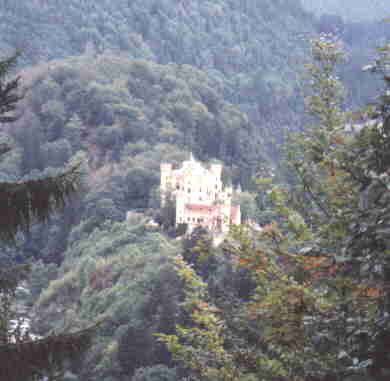
The village of Schwangau is also home to the famous castle Neuschwanstein. With a lake on one side and a beautiful waterfall on the other, Castle Neuschwanstein looks down upon the little hunting lodge Hohenschwangau, from a nearby mountain. Walking paths through the mountains offer spectacular views of Neuschwanstein and Hohenschwangau both perched high above the nearby lake. The photo of Hohenschwangau at right was taken along the road leading up to the castle Neuschwanstein.
Today Hohenschwangau is a privately owned castle opened to the public as a museum. The armour collection at this castle consists of two complete suits of armour, one of which shown here is my favorite, a gothic equestrian battle harness. The other armour is a 16th century armour.
This armour is similar to the armours made during the height of the gothic period. Though I don't know for sure that it is from that era, it is made exactly like an armour that was typical of the medieval period.


 Photographed December 1991.
Click on the thumbnailed photos below to see the larger pictures.
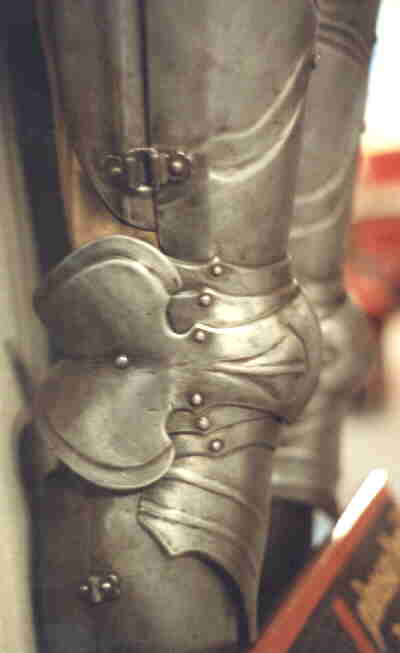
Poleyns and Couters. German in style with small extensions in the back of the poleyns and no fan shaped extensions in the front joint of the couters. German armours and those armours made in Italy for German customers, most often smaller poleyn side extensions and couter side extensions, compared with Italian armours with noticeably larger fan shaped extensions.
Something looks out of place on this armour. There is something odd that is quickly noticed when viewing this armour. Go to http://www.beautifuliron.com/looking.htm to learn more of this anomaly.
Breast and back plate are fastened with leather belts and buckles riveted to each.
Points used to support parts of this armour. The Couters are hung from points tied to the arming doublet and edges of the rerebraces and vambraces. Rerebraces and vambraces are also hung from points tied into the arming doublet. Vambraces are made in two pieces hinged together with iron hinges riveted on the outside edge and leather belts and buckles riveted to each plate near the opposite edge.

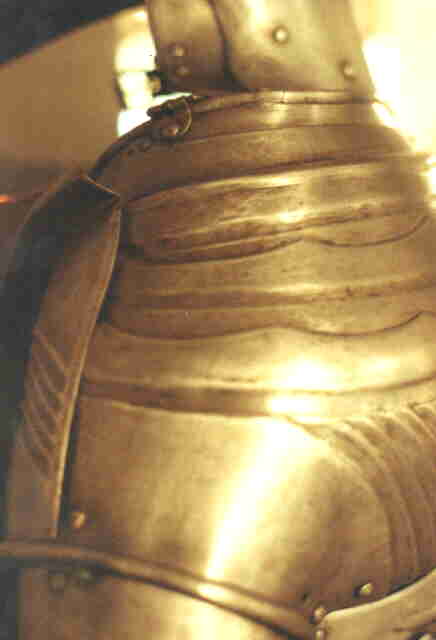
 Pauldron
supported by belt or leathers on arming doublet. To the top edge of the pauldron is riveted, a buckle which fastens
around the leather belt sewn to the neck of the arming doublet. The lower arm of the
pauldron is fastened around the wearer's arm with a leather belt and buckle riveted to the
front and rear edges of the lower pauldron lame. An additional reinforcement is riveted to
the front of both pauldrons.
Pauldron
supported by belt or leathers on arming doublet. To the top edge of the pauldron is riveted, a buckle which fastens
around the leather belt sewn to the neck of the arming doublet. The lower arm of the
pauldron is fastened around the wearer's arm with a leather belt and buckle riveted to the
front and rear edges of the lower pauldron lame. An additional reinforcement is riveted to
the front of both pauldrons.
Bevor on this armour was meant to be snapped into the breast plate. The bevor fastens to the front of the breastplate and strapped around the wearers neck with a belt and buckle riveted to the rear side edges.


 Gauntlets
are a composite design. The gauntlets are a combination mitten and finger gauntlet favored by
the Germans at that time. Every part of this armour is made for flexibility and comfort
for the wearer. The gauntlets are secured around the wrist with a pair of leather belts
and buckles. The top of the glove is sewn into the leathers riveted to the sides of the
gauntlet. Fingers are free to move inside this gauntlet and control of the gauntlet is by
the leather belt under the middle of the fingers which is riveted to the last finger lame
plate rivet, and by individual fingertip leathers which are each riveted to the end of
the last finger lame plate. Leather is riveted along the edges of the cuff to silence
them.
Gauntlets
are a composite design. The gauntlets are a combination mitten and finger gauntlet favored by
the Germans at that time. Every part of this armour is made for flexibility and comfort
for the wearer. The gauntlets are secured around the wrist with a pair of leather belts
and buckles. The top of the glove is sewn into the leathers riveted to the sides of the
gauntlet. Fingers are free to move inside this gauntlet and control of the gauntlet is by
the leather belt under the middle of the fingers which is riveted to the last finger lame
plate rivet, and by individual fingertip leathers which are each riveted to the end of
the last finger lame plate. Leather is riveted along the edges of the cuff to silence
them.

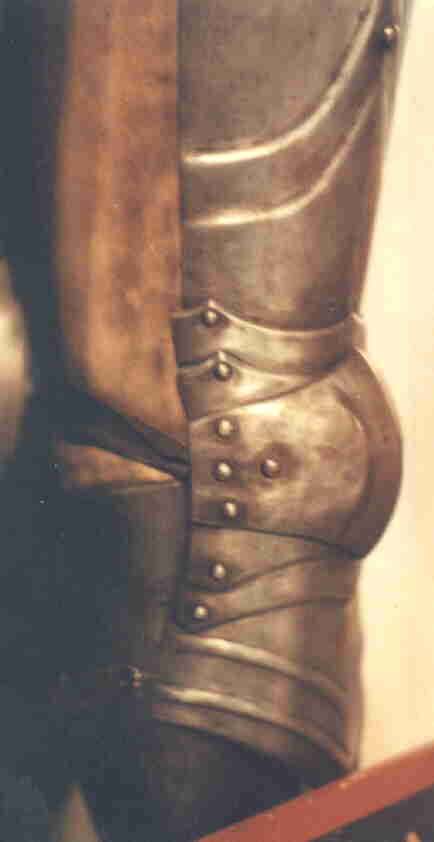

 Damaged
by time. The
leathers have long since rotted away and have been replaced. Some rivets have
also been replaced. The thumbnail photo near right shows
that the outlines and edges of some individual plate laminations no longer meet, and the
repairs that were made didn't restore the armour to its original condition. Yet this
style of armour is still a proud example of the peak of the armoursmith's trade and skill during
the late 15th century.
Damaged
by time. The
leathers have long since rotted away and have been replaced. Some rivets have
also been replaced. The thumbnail photo near right shows
that the outlines and edges of some individual plate laminations no longer meet, and the
repairs that were made didn't restore the armour to its original condition. Yet this
style of armour is still a proud example of the peak of the armoursmith's trade and skill during
the late 15th century.


 Cuisses. Upper edges of the cuisses are fastened the arming doublet with a
leather gusset riveted to the top edge of the cuisse, through which the points are tied.
Points themselves are either threaded through holes in the doublet or sewn to the doublet.
The doublet was not present with this armour. The upper rear cuisse extension lame is
secured to the lower extension with a sliding rivet and at its front by a leather riveted
to the cuisse.
Cuisses. Upper edges of the cuisses are fastened the arming doublet with a
leather gusset riveted to the top edge of the cuisse, through which the points are tied.
Points themselves are either threaded through holes in the doublet or sewn to the doublet.
The doublet was not present with this armour. The upper rear cuisse extension lame is
secured to the lower extension with a sliding rivet and at its front by a leather riveted
to the cuisse.
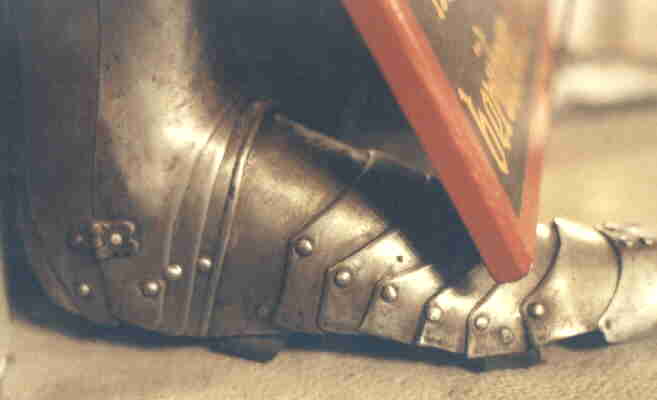
 At left
are the solarettes. Typical of the late gothic period these foot defenses have detachable
extensions mounted on the ends of the toes. Demi-poulaine I believe, since they are not as
long as some. These were merely decorative for display purposes, and detachable since a
man could not wear them in battle.
At left
are the solarettes. Typical of the late gothic period these foot defenses have detachable
extensions mounted on the ends of the toes. Demi-poulaine I believe, since they are not as
long as some. These were merely decorative for display purposes, and detachable since a
man could not wear them in battle.
This armour may be a reproduction!
Shortly after publishing this page to the internet, an armour maker from Denmark wrote to me with news that he believed this armour was a reproduction, and the original armour is located in the city of Ingolstadt in Germany. I have not had time to research this yet. If it is indeed a fake, then it has been very well executed in every detail. European blacksmiths and armourers were masters of metalwork and could easily reproduce an accurate replica.
I originally posted this update several years ago but the updates were lost during several computer crashes at that time and I didn't know that it had disappeared. Backup files did not contain the update because the crashes occurred during backup.
Important! No flash is permitted for cameras. The dim light from a pair of light bulbs makes photography very difficult, but it can be done if using 400 ISO or faster film.
Visitor information for the Hohenschwangau can be found at http://www.hohenschwangau.de/
Other websites that focus on Hohenschwangau castle: http://www.castles.org/castles/Europe/Central_Europe/Germany/germany4.htm
More info on both Neuschwanstein and Hohenschwangau can be found at http://www.neuschwanstein-hotel.com/. This is a beautiful website with lots of photos of the Bavarian architecture and countryside but there is no information about the armours at this website.
Page updated on Monday, September 16, 2019.
All pictures are originals by the author.
The author can be emailed at address in picture below:

Latest update October 30th, 2001.