Ye Old Drill
[Home]
[Back to Ye Old Drill] [Camelback
Drills] [Morse Taper]
[Standard No.
2 Chuck] [Westcott's
Little Giant Chuck] [Jacobs
Chucks] [The Post
Drill] [Restoring
Canedy-Otto No. 16]
These pages were created specifically to show some of the drills and drilling
tools that are used by blacksmiths today. Page subjects include; the camel-back
drill press, drill chucks, taper shank (also known as morse taper) tooling,
antique drills and drill repair and restoration.
Latest update
September 16, 2019.
 The
Camelback Drill. The name 'camelback' refers to the peculiar humped
cast iron center frame to which the main shaft and pulleys and gearing were built
up. The camelback has the most distinctive appearance of any drill press ever
manufactured. This is an antique style of drill press made around the end of the
19th century and well into the first half of the 20th century, and were still
being manufactured until the mid-1970s. Today these antique style drills are often
found for sale when older welding and blacksmith shops and farms go to auction.
Some people today are skeptical of these old drills - often mistakenly
believing that these old drills don't work simply because they don't look like
modern drill presses. But to those of us who use them, these old style drills are
very practical and highly desirable for nearly every drilling job. Camelback
drills turn much slower than modern drill presses, and this slower drill speed
greatly extends drill bit life by reducing the heat build-up in the drill bit. And
camelback drills operate much more quietly and smoothly than modern drill presses
- thus reducing operator fatigue. These old drills were built solid to last a
lifetime and this they certainly did, many camelbacks outlived their original
owners and continue to serve multiple generations of metalworkers today!
Click on the photo or link to go to the
Camelback Drill
page. March 27th, 2011 Under construction.
The
Camelback Drill. The name 'camelback' refers to the peculiar humped
cast iron center frame to which the main shaft and pulleys and gearing were built
up. The camelback has the most distinctive appearance of any drill press ever
manufactured. This is an antique style of drill press made around the end of the
19th century and well into the first half of the 20th century, and were still
being manufactured until the mid-1970s. Today these antique style drills are often
found for sale when older welding and blacksmith shops and farms go to auction.
Some people today are skeptical of these old drills - often mistakenly
believing that these old drills don't work simply because they don't look like
modern drill presses. But to those of us who use them, these old style drills are
very practical and highly desirable for nearly every drilling job. Camelback
drills turn much slower than modern drill presses, and this slower drill speed
greatly extends drill bit life by reducing the heat build-up in the drill bit. And
camelback drills operate much more quietly and smoothly than modern drill presses
- thus reducing operator fatigue. These old drills were built solid to last a
lifetime and this they certainly did, many camelbacks outlived their original
owners and continue to serve multiple generations of metalworkers today!
Click on the photo or link to go to the
Camelback Drill
page. March 27th, 2011 Under construction.
 The
Post Drill. So what do you do if you need to drill a steel machine part
and don't have electricity or don't want to use a hand drill. Well you drill it on
your post drill. Post drills were made around the turn of the century and are
basically hand cranked drill presses that resemble modern drill presses, except
that they had no post or frame to allow them to stand on the floor by themselves.
It was a simple matter to ship one of these to a farmer or small rural shop, where
the owner would set them up on a board and bolt them to a post or beam in his barn
or shop. Many could also be hooked up through a belt, to a line shaft if the shop
was so equipped.
The
Post Drill. So what do you do if you need to drill a steel machine part
and don't have electricity or don't want to use a hand drill. Well you drill it on
your post drill. Post drills were made around the turn of the century and are
basically hand cranked drill presses that resemble modern drill presses, except
that they had no post or frame to allow them to stand on the floor by themselves.
It was a simple matter to ship one of these to a farmer or small rural shop, where
the owner would set them up on a board and bolt them to a post or beam in his barn
or shop. Many could also be hooked up through a belt, to a line shaft if the shop
was so equipped.
 What
is Morse Taper? This page introduces new machinists and mechanics to
the Morse Taper and the taper shank tooling that is used on modern drill presses.
Taper shank tooling allows the user to change and install a variety of drilling
tools including chucks, bits, reamers, threaders, adapters, and extensions, in
just seconds. Plenty of pictures make this introduction quick and pleasant. Lots
of photos on this page show how the morse taper is used in both older style drills
as well as modern style drills. This article gives the reader a complete
description of how the Morse Taper works and how to identify drills using the
Morse Taper. Using the material presented on this page, the reader can obtain MT
tooling on their own, set it up, and use it on any drill so equipped. Previous
major update December 5th, 2004. Click on the photo or link to go to the
Morse Taper page.
What
is Morse Taper? This page introduces new machinists and mechanics to
the Morse Taper and the taper shank tooling that is used on modern drill presses.
Taper shank tooling allows the user to change and install a variety of drilling
tools including chucks, bits, reamers, threaders, adapters, and extensions, in
just seconds. Plenty of pictures make this introduction quick and pleasant. Lots
of photos on this page show how the morse taper is used in both older style drills
as well as modern style drills. This article gives the reader a complete
description of how the Morse Taper works and how to identify drills using the
Morse Taper. Using the material presented on this page, the reader can obtain MT
tooling on their own, set it up, and use it on any drill so equipped. Previous
major update December 5th, 2004. Click on the photo or link to go to the
Morse Taper page.
 The
Standard #2 Drill Chuck. The Standard #2 Improved
is an antique 3/4th-inch drill chuck seen on many antique tool catalogs with drill
presses. These antique style chucks were very common during the late 1800's and
early 1900's before the introduction of the Jacobs style chucks. This drill chuck
was mounted in my drill when I bought my Cannedy-Otto New #16.
March 27th, 2011 This page under major construction now.
The
Standard #2 Drill Chuck. The Standard #2 Improved
is an antique 3/4th-inch drill chuck seen on many antique tool catalogs with drill
presses. These antique style chucks were very common during the late 1800's and
early 1900's before the introduction of the Jacobs style chucks. This drill chuck
was mounted in my drill when I bought my Cannedy-Otto New #16.
March 27th, 2011 This page under major construction now.
 Westcott's
Little Giant Drill Chuck. The Westcott's Little Giant is an antique
1-inch drill chuck seen on many antique tool catalogs with drill presses. These
antique style chucks were very common during the late 1800's and early 1900's
before the introduction of the Jacobs style chucks. One of my readers sent these
photos to me. March 27th, 2011 New Page. Under construction.
Westcott's
Little Giant Drill Chuck. The Westcott's Little Giant is an antique
1-inch drill chuck seen on many antique tool catalogs with drill presses. These
antique style chucks were very common during the late 1800's and early 1900's
before the introduction of the Jacobs style chucks. One of my readers sent these
photos to me. March 27th, 2011 New Page. Under construction.
 Jacobs
Drill Chuck. On this page is detailed the cleaning and restoration of
an old No. 3 Jacobs heavy duty drill chuck, and the replacement of the chuck jaws.
Anyone who has ever wondered what a Jacobs chuck looks like inside, and anyone who
has a chuck with worn or stuck parts will find this page of interest. Tips and
photos of chuck disassembly, inside the parts, and installation and removal of
arbors is described in text and photo. Sources for info and parts are given as
well. Updated December 5th, 2004.
Jacobs
Drill Chuck. On this page is detailed the cleaning and restoration of
an old No. 3 Jacobs heavy duty drill chuck, and the replacement of the chuck jaws.
Anyone who has ever wondered what a Jacobs chuck looks like inside, and anyone who
has a chuck with worn or stuck parts will find this page of interest. Tips and
photos of chuck disassembly, inside the parts, and installation and removal of
arbors is described in text and photo. Sources for info and parts are given as
well. Updated December 5th, 2004.
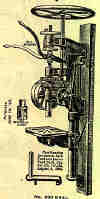 The
Otto Canedy New #16 Drill. Here is described the restoration progress
on a 100 year old drill press to bring it back to serviceable condition. Lots of
pictures and more to be added as work progresses.
Restorations on this drill has stalled due to lack of time to work on it.
The
Otto Canedy New #16 Drill. Here is described the restoration progress
on a 100 year old drill press to bring it back to serviceable condition. Lots of
pictures and more to be added as work progresses.
Restorations on this drill has stalled due to lack of time to work on it.
Latest update
September 16, 2019